
Aims
Using the water protection areas managed by Stadtwerke Bühl as a case study, BioWaWi-KI is investigating how artificial intelligence can help preserve biodiversity and ecosystem services in water protection areas. The focus is on how changes in the water cycle caused by droughts, heavy rainfall, and other environmental changes affect biotopes and species
To this end, the project combines extensive environmental and biodiversity data with hydrological models, remote sensing, and AI methods. Weather, soil moisture, groundwater, and surface water are taken into account, as are soil properties, vegetation, biotopes, and selected animal and plant species. Satellite and camera data supplement field measurements. This approach aims to reveal correlations that are difficult to identify when individual data sources are analyzed in isolation.
A key target is the development of an AI-based early-warning system. It is designed to detect critical changes in the water balance and potential consequences for moisture-dependent species and biotopes as early as possible. In addition, the project will examine various scenarios, such as the effects of prolonged droughts or potential measures to stabilize the landscape’s water balance.
In this way, BioWaWi-KI takes a strongly application-oriented approach. The results are intended to help water suppliers better integrate biodiversity and ecosystem services into the management of their water protection areas. This is because intact ecosystems are also important for water supply—including groundwater recharge, water quality, and the filtering and buffering functions of the soil.
Structure and Work Packages
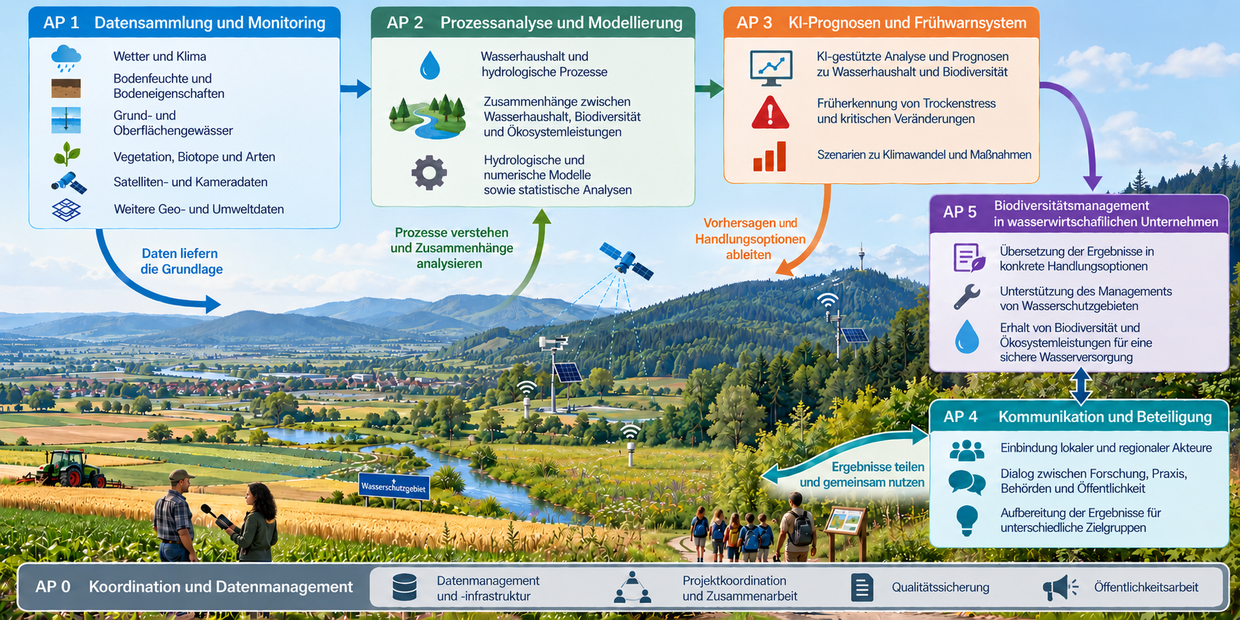
BioWaWi-KI combines field research, environmental monitoring, process modeling, and AI development with practical application at a water utility. The work is divided into six interconnected work packages. The data collected in the field forms the basis for understanding the processes and for the AI models. The results are then incorporated into practical applications and biodiversity management. This structure is also reflected in the project’s work plan as a sequential process
WP 0 – Coordination and Data Management:
This work package provides the organizational framework for the project. In addition to project coordination, it includes joint data management, coordination among project partners, and public relations.
WP 1 – Data Collection and Monitoring:
BioWaWi-KI is based on extensive measurements and field surveys. Data collected includes weather and soil moisture, groundwater levels and surface water bodies, as well as vegetation and selected animal and plant species. This data is supplemented by pedological surveys, satellite data, and other geodata. In addition, a control center is being set up at Stadtwerke Bühl, where monitoring data—and later also model and forecast results—will be consolidated.
Work Package 2 – Process Analysis and Modeling:
Here, the relationships between the water cycle and biodiversity are investigated. The focus includes, among other things, the spatial and temporal dynamics of soil moisture, hydrological and hydrogeological processes, and their impact on species and biotopes. In addition to statistical and machine learning methods, physical and numerical models are also used for this purpose.
WP 3 – AI Forecasts and Early Warning System:
Based on the monitoring data and the understanding of processes gained, AI methods are being developed to estimate future changes in the water cycle and their impacts on biodiversity and ecosystem services. A key focus is on the early detection of drought stress and the development of scenarios from which courses of action can later be derived.
WP 4 – Communication and Participation:
Local and regional stakeholders are involved in the project. This is intended to incorporate practical experience and local knowledge into the research while ensuring that the results are presented in a way that makes them useful for water utilities, government agencies, nature conservation organizations, and other stakeholders.
WP 5 – Biodiversity Management in Water Management Companies:
This is where the results of the project are applied in practice. In collaboration with Stadtwerke Bühl, scientific findings, monitoring data, and AI-based forecasts are translated into actionable options for the management of water protection areas. The target is to more firmly anchor biodiversity and ecosystem services in the environmental management of water management companies over the long term. As a practical partner, Stadtwerke Bühl serves as the central interface between research and application.