
Research
Overview of the Scientific Concept
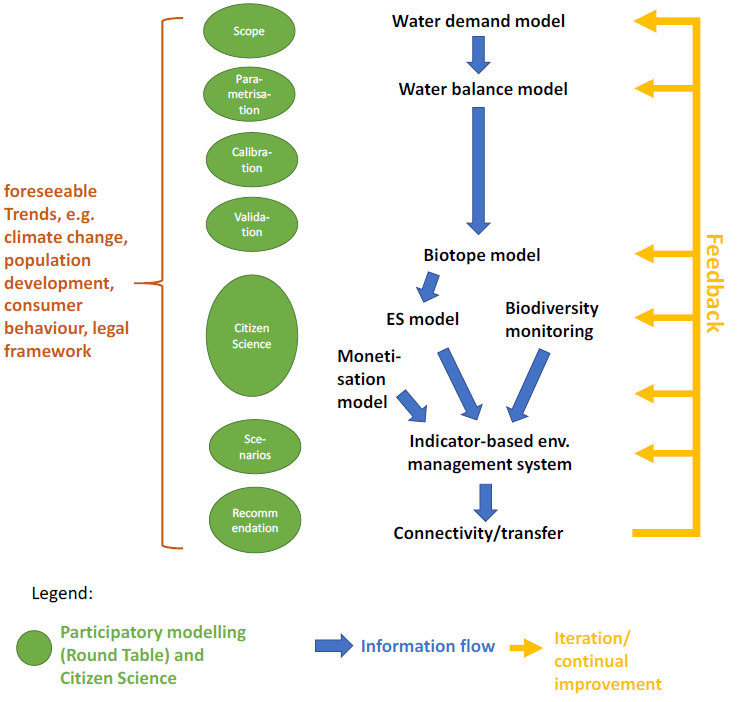
The following steps are illustrated in the figure:
- Defining the scope of the study: Based on the water demand model, stakeholders are informed about SWB’s water needs; concerns and suggestions are gathered, discussed, and documented. Conflicting objectives are addressed. Based on this, a list of questions is developed at the roundtable to be answered through modeling.
- Parameterization: The stakeholders’ local knowledge is incorporated into the identification of relevant parameters. The roundtable is informed about the intended parameterization, and, if necessary, parameters are reevaluated or their weightings are adjusted.
- Calibration: The model can be calibrated using events that have occurred within a timeframe that local stakeholders can readily assess. To this end, backward calculations are performed using the model for relevant events affecting the water balance (floods, heavy rainfall, droughts), which are then independently compared with the stakeholders’ experiences. Based on these comparisons, the model’s spatial resolution can be calibrated.
- Validation: Validation is performed through forward calculations of water balance events during the course of the project. These are discussed at roundtable meetings, which are convened on an ad hoc basis in the event of specific water balance events (areas drying out, rising groundwater levels following heavy rainfall, etc.). If the model can predict such events, the functionality of the modeling approach for assessing the environmental impacts of the municipal utilities’ water management measures can be considered reliable.
Participatory modeling serves four targets:
- quality assurance of the modeling through local knowledge,
- to identify and resolve potential conflicts of interest between water management, nature conservation, and species protection,
- building trust between local stakeholders and the project’s scientists,
- ensuring the applicability of the project results by resolving these conflicts over the course of the project.
By involving an advisory board—which includes other water utilities as well as the Technology Center for Water and the Federal Agency for Nature Conservation—practical experience and insights from other regions and stakeholder groups are specifically incorporated. The implementation of this project is intended to serve as a model that can be applied to other water utilities.