
Project Structure and Work Packages
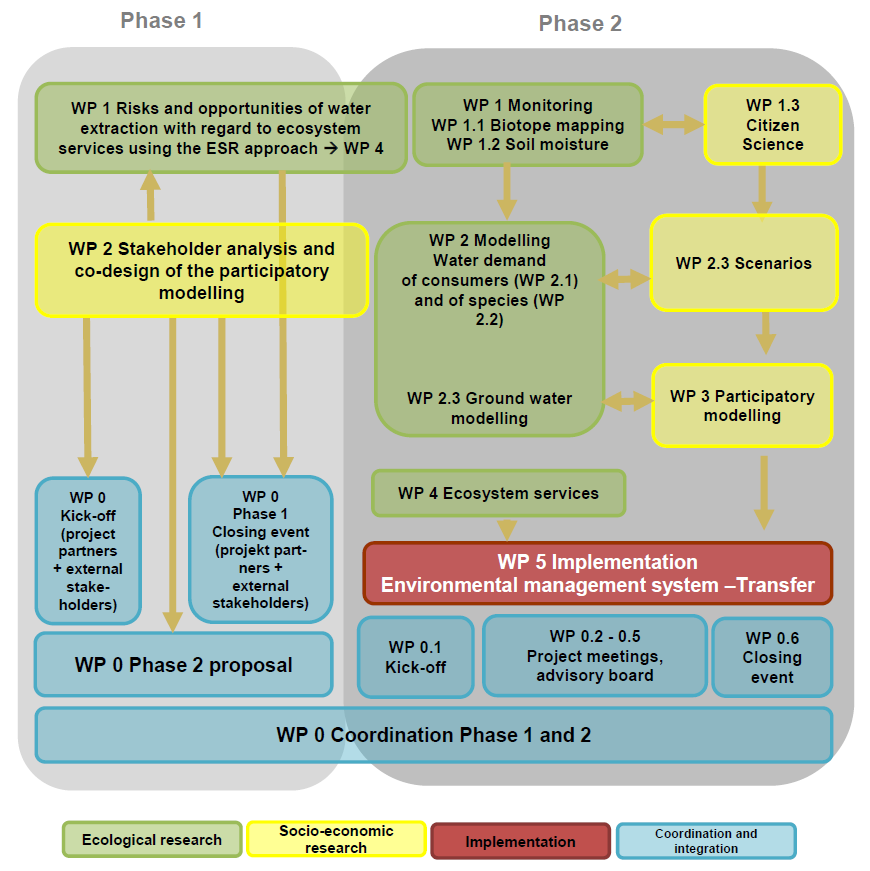
The figure provides an overview of the work carried out in Phase 1, which was conducted as part of the definition project, and Phase 2, which is currently underway. Project coordination and advisory board work (WP 0) are handled by KIT-AGW and DIALOGIK. The research and development work is organized into five work packages, WP 1 through WP 5. Each work package comprises several activities or work steps, each of which is carried out by one or more subprojects. Regardless, the work packages are considered joint tasks.
Project Objectives
The main objective of the project is to integrate the value of biodiversity, ecosystems, and ecosystem services (EES) into the decision-making processes of municipal water utilities; this will be developed and tested using Stadtwerke Bühl (SWB) as a case study. The aim is to ensure that the results are transferable to other companies in the water sector, with the goal of encouraging them to adopt environmental management systems that are more strongly focused on species conservation and promotion.
BioWaWi focuses on the following project priorities:
- The integration of biodiversity and ecological quality standards into environmental management systems: This will be achieved using ecological indicators (e.g., trends in target organisms, groundwater levels, soil moisture, precipitation) and/or economic indicators (e.g., biotope value points, eco-account, monetization of ecological services).
- Recording changes in biodiversity through before-and-after monitoring. With the support of a citizen science approach, species and habitat mapping will be conducted. The target organisms or indicator species will be identified in collaboration with local stakeholders at the roundtable.
- To record abiotic indicators, a water balance monitoring system will be established for the managed water protection areas (groundwater levels, soil moisture, precipitation).
- Through participatory modeling of the water cycle, the knowledge of local stakeholders will be incorporated into this process, while simultaneously building trust in the scientific methodology, which will enable the implementation of the research results.
- The economic assessment will be tailored to the selected indicators. A corresponding methodology, taking existing tools (e.g., Ökokonto) into account, will be developed.
- The scientific methodology is accompanied by regular roundtable discussions with local stakeholders, moderated according to mediation criteria. During the roundtable discussions, efforts will be made to align water and land management options with public acceptance (e.g., attractiveness of biotopes, recreational potential).
- The transdisciplinary, collaborative approach within the project is ensured through regular project meetings and training sessions for staff using the methodology of peer coaching.
These targets lead to the development of a methodology for an environmental management system for municipal utilities, designed to optimally manage existing water resources—balancing ecological and economic considerations under the conditions of climate change, population trends, and applicable legal requirements, and to ensure the preservation of biodiversity and water quality.